Photo by 7500 RPM
The end-of-the-week meltdown of Oracle, coupled with Sam Altman’s admission that his Open AI team has no idea what it’s doing, has many hoping that the AI bubble is about to burst. It’s too early to know whether we have yet seen the Bear Stearns moment of the AI bubble, but we should be on guard against another bad moment of the housing bubble: the bank bailouts.
To remind folks, when most of the major banks’ greed put them at the edge of bankruptcy as the housing bubble collapsed, the government rushed to the rescue with trillions of dollars of cash, loans, and guarantees. They justified this massive intervention with the Big Lie: if we didn’t save the banks, we would be hit by the Second Great Depression.
The Big Lie was solemnly repeated in both opinion and news pieces across the political spectrum. Leading Democrats, like soon-to-be President Obama and House Speaker Nancy Pelosi, pushed it as hard as then-President George W. Bush and his cabinet. Dissenting opinions were largely excluded from polite discussion.
To be clear, allowing the free market to work its magic and put most of our largest banks out of business, along with many smaller ones, would have made the recession worse. But it would have done more to reduce wealth inequality than twenty Piketty wealth taxes. (Everyone’s bank accounts were guaranteed by the FDIC, so all but the wealthy would still have full access to their money.) However, the idea that we would have faced a decade of double-digit unemployment without the bailouts was complete nonsense.
We know how to get out of a depression: you spend money. That’s what we did with World War II. We spent a ton of money, and the economy came roaring back. It’s true this was due to a huge war, but war does not have a magical impact on the economy. If we spent the same money ten years earlier on building up the nation’s housing and infrastructure, as well as our health care and education system, we would not have the first Great Depression.
In the crash of the housing bubble case, we could have spent big time on health care, childcare, and other needs, quickly boosting the economy back to full employment. We managed to do that just over a decade later in response to the COVID-19 pandemic.
But the politicians, the big money folks, and the media were not going to allow reality into the discussion. They wanted the taxpayers to save their banks and the bloated financial industry. They were prepared to say whatever was necessary to accomplish this goal.
The Second Great Bailout?
This digression is useful because people should be aware of how reality can be tossed by the wayside when the rich and powerful demand something from the government. We can’t know yet whether the Oracle meltdown, and the AI leaders’admission that they don’t know what they are doing, will be enough to force the big money actors in the stock market to look at arithmetic, but we can hope.
And if they do see reality, and the bubble begins to deflate, and the big AI companies head towards bankruptcy, we can predict what the politicians they bought will look to do: give them huge piles of taxpayer dollars. It wasn’t for nothing that Sam Altman, Elon Musk, and the rest showered Donald Trump with money. They also have many Democratic politicians on their gift list as well. So, we need to ask what the bailouts can look like.
The most obvious one is handing OpenAI, Anthropic, and SpaceX huge piles of money with the idea that the government is getting a stake in these companies. The claim that this would be a good idea follows the illusion that the AI companies are about to make unbelievable profits. There is no reason to think this is the case, as many of us have been arguing, and the markets might now be realizing. This would just be giving massive sums of money to some of the richest and worst people on the planet.
The idea that a government stake will allow more effective control is almost as wrongheaded. Can anyone really believe that Donald Trump, with top-level appointees like Pete Hegseth, RFK Jr., and Sean Duffy, will assign serious people to oversee the government’s stake in AI companies?
The widely recognized safety concerns with AI (it’s smaller-level disasters, not human extinction) should best be dealt with as criminal matters. Instead of begging the AI companies to slow down, we should be demanding legal action that threatens the company’s money and possibly means jail time for top execs. It is illegal to break into another company’s website. And to be clear, it was done on purpose, since they designed AI systems which they did not understand. They don’t have to do this; they did it for profit.
And to be clear, breaking into websites in the past has been taken very seriously. The Justice Department prosecuted Aaron Swartz, a young computer whiz, threatening him with 35 years in prison. This eventually drove him to suicide. His crime was breaking into JSTOR, a system for academic publications, with the intention to make them freely available online. Compare that to Sam Altman hacking into possibly thousands of systems, with the goal of making himself a trillionaire.
If we can knock the straight handout idea off the table, the next possibility is loans. This gives the convenient line that “it doesn’t cost us anything; they will pay us back, with interest.” A first point should be clear: we will be giving loans at below the market rate, since if we weren’t, there would be no point. Giving hundreds of billions, or trillions, in loans at below-market rates could be a great deal of money.
The other point is that we can end up piling loans upon loans to keep the AI companies and the illusion alive. This is the old story of throwing good money after bad. If we have $500 billion that the government could lose in a bankruptcy, isn’t it worth coughing up another $50 or $60 billion to keep OpenAI or SpaceX alive? There will also be the temptation to throw these companies government contracts, where we overpay or pay for items that are not needed. (This is also true where the government has a stake.)
The other bailout route is guarantees. In this case, they can again use the line that it doesn’t cost us anything. This also is nonsense. There is a huge market for credit default swaps, which are essentially insurance that bonds are repaid. If we provide guarantees for hundreds of billions of dollars for loans to the AI companies and/or the hyperscalers, this could amount to a massive handout to the AI boys.
What we should really want is for the market to work its magic. If the demand for the frontier AI models doesn’t justify the trillions of dollars of investment currently scheduled, and/or the risks outweigh the benefits, we should stop it as soon as possible. The resources in building out the data centers can be better used elsewhere.
That’s what the market would be telling us in a meltdown. It would be a good idea to listen this time.
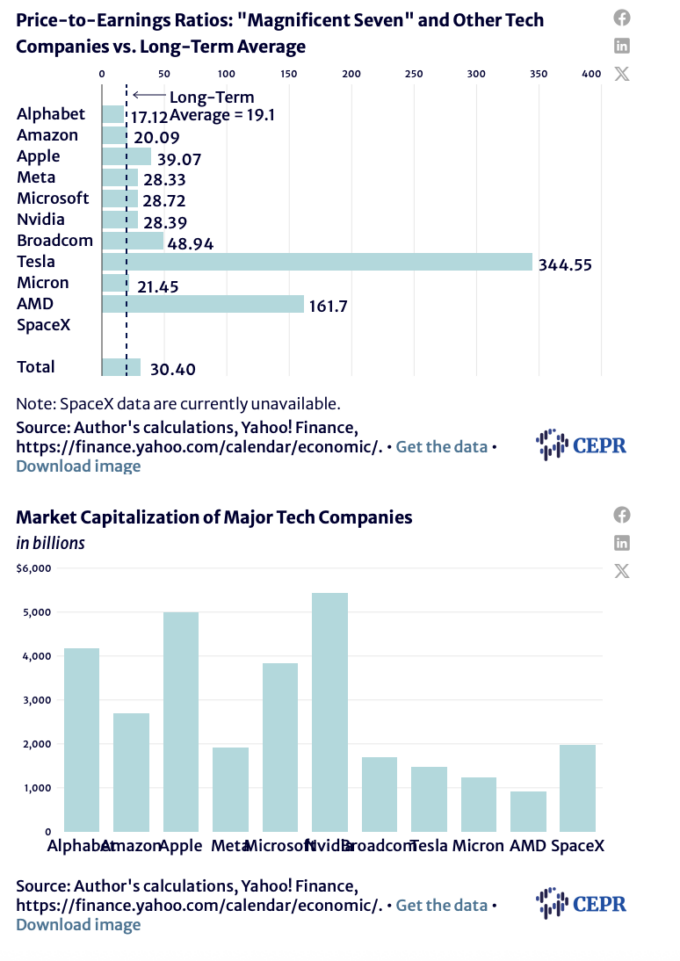
All that said, here are the numbers for the past week:
This first appeared on Dean Baker’s AI Bubble Monitor blog.